

The Hidden Broadband Dividend: How Buying DTE’s Poles Could Light Up Ann Arbor’s 44 Miles of Dark Fiber
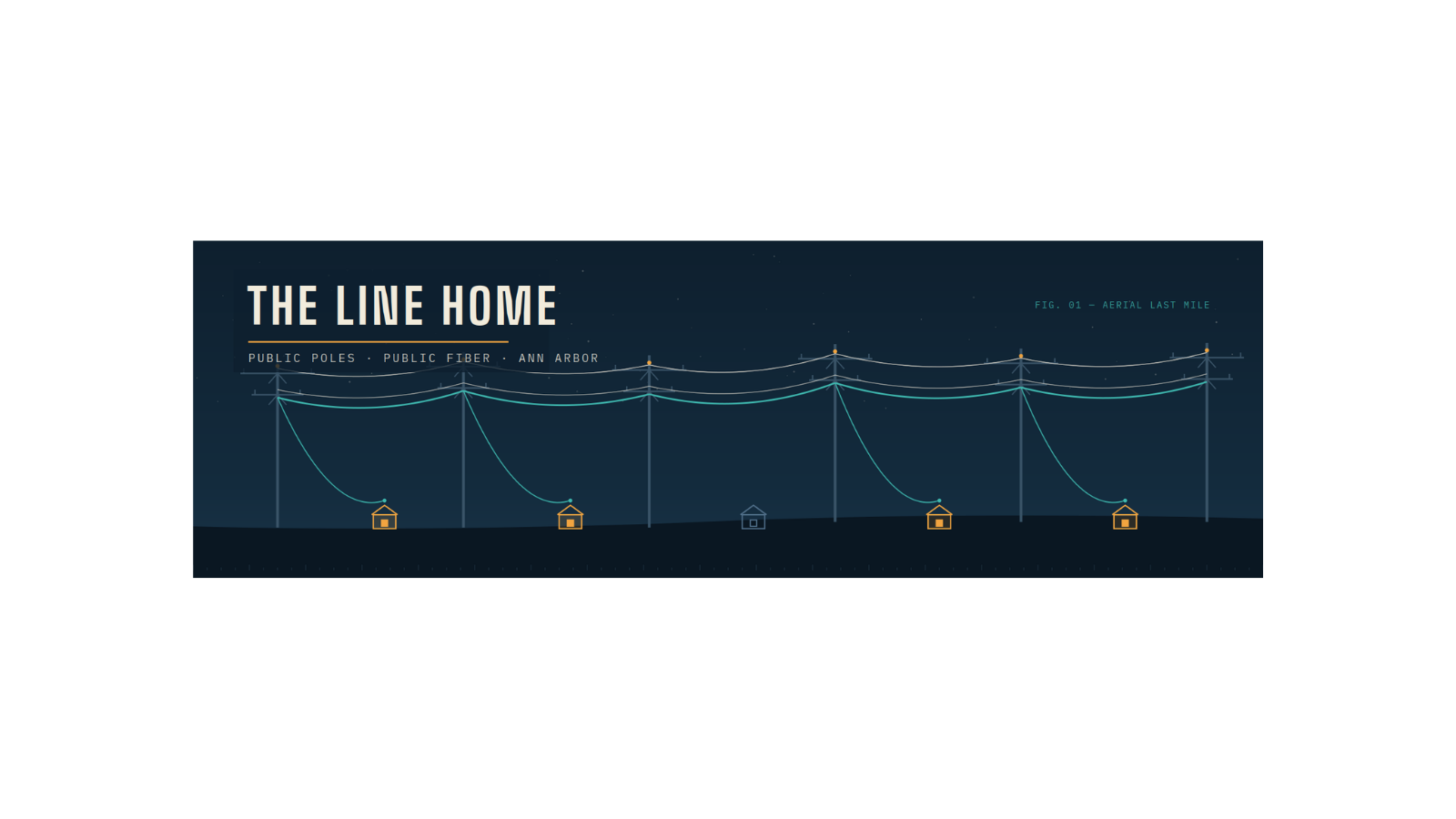
When Ann Arbor debates municipalizing its electric grid, the conversation is usually about kilowatt-hours, outages, and carbon. But there’s a second utility hiding inside the first one: every utility pole the city acquires from DTE is also a fiber route to someone’s front door.
Two public assets, one missing link
Ann Arbor already owns a serious piece of broadband infrastructure that most residents have never heard of. According to the city’s own IT Service Unit, Ann Arbor has more than 44 miles of backbone fiber optic cable within city limits, with an additional 20 miles planned to extend to Ypsilanti. This isn’t a vague plan — it’s built, in the ground, and operating today.
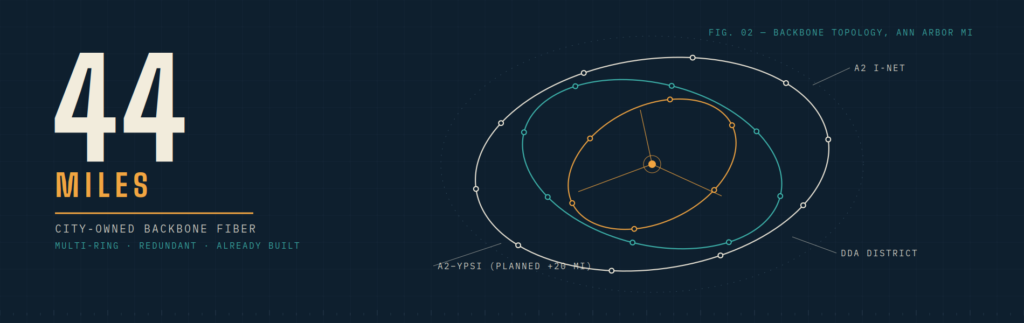
The city describes it as three physical networks that can operate independently or be joined into one:
- A2 I-NET — the citywide institutional network connecting municipal facilities
- Technology Park / DDA District — a downtown network serving the Downtown Development Authority footprint
- A2–Ypsilanti Broadband — the planned 20-mile regional extension
Each network is engineered in a multi-ring configuration with central termination and patching, meaning failover, resiliency, and redundant physical paths are designed in from the start. The city already leases this capacity as dark fiber to public and commercial organizations under a Fiber and Conduit Use Agreement, at a published rate of roughly $12,000 per fiber pair per year in maintenance and usage fees (plus modest replacement-cost charges). The city’s own stated goals for the network read like a community broadband mission statement: bridging the digital divide, promoting economic development, leveraging city investments for community benefit, and providing “the foundation for a ‘connected’ community.”
So the backbone exists. What Ann Arbor does not have is an affordable, city-scale way to get from that backbone to 50,000 front doors. That last mile — the drop from the street to the home — is where community fiber projects across the country stall out.
And the single biggest physical obstacle in the last mile is the utility pole.
Why poles are the chokepoint
If you want to string aerial fiber down a residential street in Ann Arbor today, you need permission to attach to poles owned overwhelmingly by DTE Energy (and in some corridors, AT&T). That means:
- Pole attachment applications and fees — recurring annual per-pole rental charges, typically in the range of $20–$40 per pole per year for communications attachments.
- Make-ready work — before a new attacher can hang cable, existing lines often must be moved to create clearance. The pole owner controls the schedule and much of the cost, and make-ready commonly runs $500 to several thousand dollars per pole in complicated spans.
- Timeline risk — make-ready delays measured in months or years are the most commonly cited killer of competitive and municipal fiber builds nationwide. The incumbent pole owner has little incentive to hurry a competitor onto its infrastructure.
The alternative — trenching underground past every home — typically costs 3 to 5 times more per mile than aerial construction. This is precisely why so many communities with great middle-mile fiber (like Ann Arbor’s 44 miles) never manage the leap to fiber-to-the-home (FTTH).
Now consider what changes if Ann Arbor acquires DTE’s local distribution system, as Ann Arbor for Public Power (A2P2) has proposed and is currently petitioning to put before voters. The Phase 1 feasibility study commissioned by the city estimated full municipalization at $281 million to $1.1 billion — a serious number, and one usually debated purely in electricity terms. But an acquisition would also transfer every distribution pole in the city into public ownership.
At that moment, the last-mile chokepoint disappears:
- No attachment rent paid to a third party. The city attaches to its own poles.
- Make-ready on the city’s schedule, coordinated with the electric utility it now also runs — the same crews, the same work orders, the same trucks.
- Joint-build economics. Every planned pole replacement, storm-hardening project, or line upgrade becomes an opportunity to lash fiber at marginal cost. This is exactly how Chattanooga’s EPB and dozens of other municipal electric utilities built FTTH affordably: the electric side and the fiber side share poles, conduit, trucks, and billing systems.
The 44-mile backbone stops being a stranded asset for institutions and becomes the spine of a citywide network.
What the numbers could look like
The figures below are illustrative estimates, not a feasibility study. Assumptions are stated so readers can adjust them. All dollar figures are rough planning numbers in today’s dollars.
Baseline assumptions
| Assumption | Value | Basis |
|---|---|---|
| Ann Arbor households | ~50,000 | U.S. Census (city of ~120,000+ residents) |
| Typical incumbent broadband bill | ~$75–$90/month | Prevailing cable/fiber pricing after promo periods, incl. equipment fees |
| Municipal FTTH gigabit price | ~$50–$60/month | Comparable munis: Chattanooga EPB ( |
| Household savings | ~$25/month average | Difference above, conservatively rounded |
| Take rate | 40% by year 5, 55% by year 10 | Municipal FTTH networks routinely reach 40–60%; Longmont exceeds 60% |
Connection trajectory (illustrative)
- Years 1–3 (buildout begins): 8,000–12,000 households passed and connected, prioritizing neighborhoods adjacent to the existing 44-mile backbone and areas with the fewest broadband choices.
- Year 5: ~20,000 subscribing households (40% take rate).
- Year 10: ~27,500 subscribing households (55% take rate), with essentially all ~50,000 households passed and able to subscribe.
Cumulative household savings (illustrative)
| Period | Avg. subscribers | Annual savings | Cumulative |
|---|---|---|---|
| Years 1–3 | ~10,000 | ~$3.0M/yr | ~$9M |
| Years 4–5 | ~18,000 | ~$5.4M/yr | ~$20M |
| Years 6–10 | ~25,000 | ~$7.5M/yr | ~$57M |
| 10-year total | — | — | ~$85M |
Add secondary effects and the number grows:
- Avoided pole rent and make-ready: attaching to ~20,000–25,000 city-owned poles instead of renting saves an estimated $500,000–$1M per year in attachment fees alone, plus millions in one-time make-ready costs — savings that flow directly into lower subscriber rates.
- Competitive discipline: everywhere municipal fiber launches, incumbents cut prices or upgrade speeds for non-subscribers too. Even households that never switch benefit. A conservative $5/month market effect across the remaining
22,000 households adds **$1.3M per year** in community-wide savings. - Digital equity: a public network can offer a genuine low-income tier (Chattanooga offers ~$27/month; some munis offer free service to qualifying student households) — closing the affordability gap that commercial ISPs address only through temporary federal subsidy programs.
A reasonable planning-level estimate, then: on the order of $85–110 million in cumulative household broadband savings over the first decade, with 25,000–28,000 households subscribed and all ~50,000 passed. Against the electric-side acquisition debate — where the Phase 1 study’s range spans $281M to $1.1B — the broadband dividend is not a rounding error. It is a material offset that belongs in the municipalization math.

The affordability logic, in one paragraph
Public power advocates already point out that Michigan’s municipal electric customers pay substantially less than investor-owned utility customers — roughly 12¢/kWh in Chelsea and Holland versus about 21¢/kWh at DTE, and about 25% less statewide according to the American Public Power Association. The broadband version of that same logic is even stronger, because the city isn’t starting from zero: the 44-mile backbone is already paid for, the SEU (approved by 79% of voters in 2024) is already building city capacity to run networked energy infrastructure, and pole ownership eliminates the single largest cost and delay driver in last-mile construction. A city that owns the poles, the backbone, the conduit, and the electric utility can deliver a gigabit for the cost of a couple of streaming subscriptions — permanently, and accountable to voters rather than shareholders.
Where this fits in the current debate
Ann Arbor for Public Power is now collecting signatures to place a municipal utility question before voters, with a potential acquisition vote later this decade. DTE, unsurprisingly, opposes the effort and funded a study projecting billion-dollar costs — figures A2P2 has contested in detail as inflated. Wherever one lands on the electric-side numbers, the broadband dividend has been largely absent from the public conversation. It shouldn’t be. Any Phase 2 feasibility study should explicitly model joint electric-plus-fiber deployment, because that is how the most successful municipal utilities in America — Chattanooga, Longmont, Cedar Falls, Wilson — actually built their networks and their balance sheets.
Ann Arbor already owns the spine. Municipalization would hand it the limbs. The only question is whether the city counts that value when it decides.
Sources & further reading
- City of Ann Arbor, “A2 Community Dark Fiber Access and Availability” (a2gov.org) — 44+ miles of backbone fiber, three-network architecture, dark fiber leasing terms
- Michigan Daily, “City Council votes to postpone Phase II study” (Jan. 2025) — Phase 1 study cost range of $281M–$1.1B
- Planet Detroit, “Ann Arbor voters could form city-owned utility” (Mar. 2026) — A2P2 ballot campaign status; APPA finding that Michigan public power customers pay ~25% less
- Ann Arbor for Public Power, FAQ and CRA study response (annarborpublicpower.org)
- Chattanooga EPB and Longmont NextLight published residential pricing — municipal gigabit benchmarks
Estimates in this post are the author’s planning-level projections based on the stated assumptions and publicly documented comparables. They are intended to inform the scope of a formal feasibility analysis, not substitute for one.