
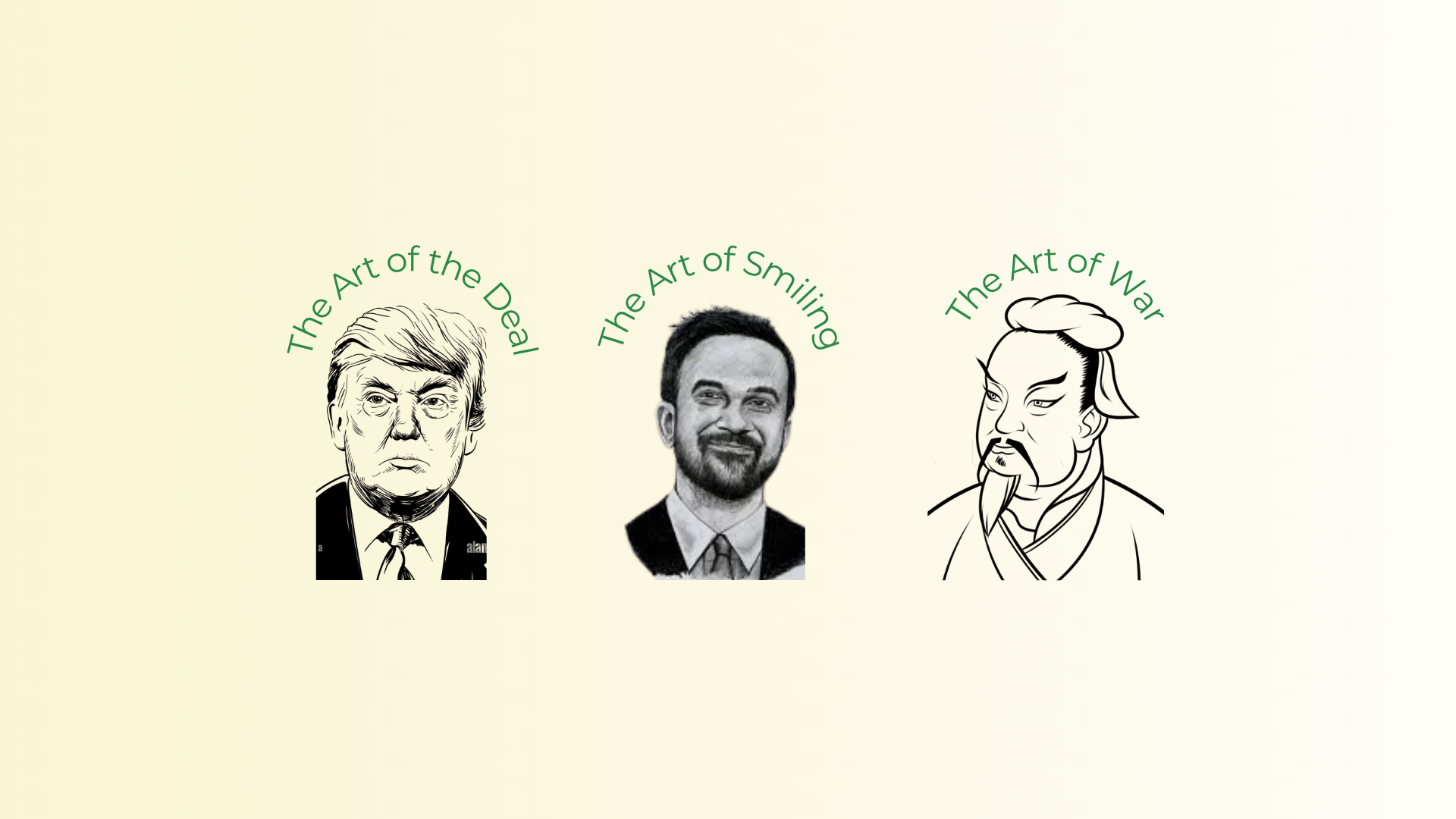
Did Mamdani read Sun Tzu before meeting Trump?
Or, was it Zohran’s smile? Were you surprised by Trump’s meeting with Mamdani? In the early 1990s two of us would drive 40 minutes from Ann Arbor to Ford Motor Company four days a week. We did millions of dollars in consulting to bring about a paradigm shift from paper shuffling and green screens to cross platform GUI solutions on Mac, PC and UNIX. We moved work out of silos and enabled product planning collaboration across managers from disparate areas like marketing, engineering, and finance. The two of us would take turns driving to Ford, while the other would read a random passage from “The Art of War” by Sun Tzu. We purposefully chose a random passage in a fashion similar to using the I Ching. We would then discuss the implications that lesson would have for how we were interacting with managers at Ford during that day. Whether or not. Mamdani was thinking about “The Art of War,” let’s dive into what happened.
here is the full length video
Most people have only seen short clips shown on the news. The video is followed by a detailed analysis we have quoted.
video commentary
Thirty Minutes in the Lion’s Den: The Interview Trump Thought He Controlled
White Rose USA — November
There’s a strange thing that happens when you watch the full thirty-minute interview instead of the clipped version the internet tosses around. The edges soften. The masks slip. And you start to see the actual geometry of the interaction — where power sits, where insecurity leaks, where the tone changes, where the truth speaks by accident. The viral clip makes it look like a moment. The full meeting reveals a dynamic.
This wasn’t a showdown. It wasn’t a humiliation. It wasn’t a triumph for either man. It was something far more revealing: a case study in how a bully behaves when he can’t rely on fear, and how a principled politician behaves when he refuses the role of the victim.
The meeting begins as all Trump meetings do — with noise.
The first five minutes are pure Trump: monologues disguised as greetings, numbers inflated beyond physics, scattered recollections of the 1980s like the era froze and preserved him in amber. You can practically hear his brain flipping through its greatest hits, trying to set the tone: This is my room. My chair. My story.
But Mamdani doesn’t react to any of it.
And that is the first hinge of the meeting.
A man like Trump needs emotional feedback to function. Fear works. Flattery works. Even anger works. Mamdani gives him nothing. He sits there with the calm of someone who refuses to let the other person set the emotional tempo. It’s a small thing, but with Trump, it’s enough to break the cycle.
Then comes the shift — the “gracious Trump” phase.
People mistake this for maturity or diplomacy. It’s not. It’s a reflex Trump only deploys when he can’t dominate the room. The tone goes soft, the eyebrows lift, the compliments come out in forced, syrupy bursts.
“You’re doing great work.”
“New York is lucky to have you.”
“You’re a very smart guy.”
It sounds statesmanlike until you remember the same man called him a communist threat two weeks earlier. What’s happening here isn’t respect — it’s adaptation. A chameleon trying to match the color of the wall.
Trump is gracious when graciousness benefits Trump.
As Mamdani shifts to policy, Trump drifts into autobiography.
This is the most telling stretch — minutes twelve to eighteen. Mamdani tries to talk like a mayor-elect:
transit
housing
Rikers
federal cooperation
immigrant protections
Real issues, real stakes, real governance.
Trump responds by vanishing into his own mythology. Crime statistics from memory that don’t exist. Grievances about prosecutors. Stories from “the old days.” Complaints about how unfairly he’s been treated.
It’s not sabotage — it’s incapacity.
Mamdani is speaking a civic language Trump’s brain can’t decode.
They aren’t having the same conversation.
They aren’t even on the same continent.
Then comes the moment everyone’s dissecting — the “fascistic tendencies” line.
And yes, it happened in the room, not after. Mamdani doesn’t weaponize the word. He doesn’t turn it into a headline. He does something more dangerous: he analytically names the pattern.
Immigrant raids.
Political retribution.
Targeting dissent.
Erosion of checks and balances.
Threats against the judiciary.
He lays out the evidence and names the behavior: fascistic tendencies.
Trump nods and smiles like someone being told he has an excellent golf swing.
It’s not bravado. It’s not denial.
It’s something almost sadder: he doesn’t understand the language of critique unless it’s blunt and emotional. Mamdani moved the discussion into the realm of political analysis, and Trump’s instincts don’t live there. So he simply… accepts it. Not because he agrees, but because he can’t absorb what the words actually mean.
The last ten minutes are the clearest portrait of Trump’s psyche.
Once Mamdani refuses to bend, Trump compensates by overcorrecting into flattery:
“You’re going to surprise people.”
“I feel very comfortable with you.”
“We’re going to get along great.”
It’s dominance disguised as benevolence. When Trump can’t conquer, he tries to adopt. He folds the other person into his narrative: You and I are the same. We’re allies. You approve of me. I approve of you.
It’s a kind of political camouflage — digest the threat by complimenting it.
Mamdani doesn’t take the bait.
He doesn’t fight.
He doesn’t flatter.
He just continues speaking plainly.
Which leaves Trump in the one position he hates most:
performing civility for an audience that isn’t fooled.
What the meeting really showed
The full interview isn’t about Mamdani calling Trump a fascist.
It’s not about Trump pretending to be gracious.
It’s not about a progressive mayor meeting an authoritarian president.
What the meeting showed is simpler and more damning:
Trump is only powerful when the room fears him.
Take the fear away, and he becomes oddly gentle, strangely polite, and completely unable to dominate the conversation.
People think tyrants rage because they’re strong.
But the truth is they only rage when they know the room will absorb it.
Mamdani didn’t absorb it.
So Trump didn’t rage.
He folded.
Nicely. Neatly.
Like a man who knows the cameras are watching and doesn’t want the world to see what he looks like when the mask cracks.
And if there’s a lesson here for the rest of the country, it’s this:
Fear is the oxygen of authoritarianism.
Take it away, and even a strongman starts to sound like a man.
Bruce Fanger
Perplexity’s comparison of Mamdani & Sun Tzu
Mamdani’s political rhetoric and Sun Tzu’s principles overlap in treating politics as a struggle over power and terrain, but they diverge sharply on methods: Mamdani is open, moralistic, and movement‑oriented, whereas Sun Tzu emphasizes secrecy, deception, and minimizing open conflict. [1][2][3] In short, Mamdani talks like a mass organizer, not a covert strategist, even though both are preoccupied with how to win. [1][2][4]
Core goals and conception of “victory”
- Sun Tzu frames victory as neutralizing an opponent with maximum efficiency, ideally “winning without fighting” through superior positioning, information, and strategy. [5][3]
- Mamdani frames victory as transforming material conditions for tenants, workers, and Palestinians—rent freezes, divestment, police reform, and foreign‑policy shifts—not just beating opponents tactically. [1][2][6]
Both see conflict as structured and systemic (not just personalities), but Mamdani’s horizon is redistributive and moral, while Sun Tzu’s is operational and outcome‑focused. [2][3]
Use of moral language vs. amoral strategy
- Sun Tzu’s text is largely amoral: it rarely uses ethical language and instead treats war as a technical problem of force, deception, and timing. [3][7]
- Mamdani routinely frames opponents and systems in explicitly moral terms—genocide, apartheid, exploitation, and complicity—and calls on supporters to act from ethical obligation, for example tying Gaza, policing, and rent into a single justice narrative. [1][2][6]
So where Sun Tzu strips conflict down to power calculus, Mamdani leans into moral clarity as a central tool of mobilization. [2][3]
Deception, openness, and communication style
- A core Sun Tzu principle is deception: appearing weak when strong, obscuring intentions, and striking unexpectedly to conserve resources and avoid direct confrontation. [5][3][7]
- Mamdani’s rhetoric is unusually forthright: he uses direct, high‑temperature statements about Zionism, Gaza, landlords, and billionaires, and he has not hidden controversial positions even when elites warned they were politically costly. [1][2][6][8]
In Sun Tzu terms, Mamdani often chooses frontal ideological confrontation where a Sun Tzu‑style strategist might soften or obscure positions to broaden coalitions. [3][4]
Terrain, forces, and “knowing the battlefield”
- Sun Tzu constantly stresses terrain, force disposition, and knowing both yourself and the enemy to choose when and where to engage. [9][3][7]
- Mamdani’s campaigns show an acute reading of political “terrain”: he centers renters in a city where most residents are tenants, builds infrastructure like Tenant Bloc to organize at scale, and links local housing pain to broader economic and foreign‑policy systems. [1][2][4]
That organizing architecture—door‑knocking rent‑stabilized buildings, foregrounding Gaza in heavily immigrant districts, and targeting specific institutional chokepoints—looks quite Sun Tzu‑ish in its attention to where power actually sits and how to concentrate forces. [1][2][6]
Direct confrontation vs. winning without battle
- Sun Tzu prefers maneuver, indirect pressure, and shaping conditions so the enemy is isolated or collapses without a decisive clash. [5][3]
- Mamdani often opts for visible confrontation—naming Zionism and apartheid, talking about arresting Netanyahu, and proposing a rent freeze that starkly divides him from more cautious Democrats. [2][6][10]
However, his emphasis on building durable tenant and movement infrastructure to shift the long‑term balance of power does echo Sun Tzu’s concern with winning through position rather than one‑off battles. [1][2][4]
Overall, Mamdani’s rhetoric aligns with Sun Tzu mainly in its attention to structural terrain and power blocs, but it diverges in its reliance on moral transparency and public confrontation rather than deception and quiet maneuver as primary tools of strategy. [2][6][3]
Sources
[1] ‘People Understand Rent Is Political’: What Zohran Mamdani’s Win … https://nextcity.org/urbanist-news/rent-political-zohran-mamdani-win-mayor-tenants-rent-freeze-nyc
[2] Zohran Mamdani and the Decline of Zionist Power in U.S. Politics https://just-international.org/articles/zohran-mamdani-and-the-decline-of-zionist-power-in-u-s-politics-from-gaza-to-new-york-city/
[3] Sun Tzu’s ‘Art of War’ Principles for Millennials and Gen Z – Headway https://makeheadway.com/blog/art-of-war-principles/
[4] Mamdani Created a Left-Liberal Coalition on Israel/Palestine https://jewishcurrents.org/mamdani-created-a-left-liberal-coalition-on-israel-palestine
[5] Sun Tzu’s Principles of War: 5 Keys to Victory – Shortform Books https://www.shortform.com/blog/sun-tzu-principles-of-war/
[6] How Zohran Mamdani Came to Embrace the Palestinian Cause https://www.nytimes.com/2025/10/08/nyregion/zohran-mamdani-israel-palestine.html
[7] [PDF] Sun Tzu: The Art of War Contents: 1.Estimates 2.Waging War 3 … https://ccnmtl.columbia.edu/services/dropoff/china_civ_temp/week05/pdfs/artofwar.pdf
[8] What NYC Mayor-elect Zohran Mamdani has actually said about … https://www.timesofisrael.com/what-nyc-mayor-elect-zohran-mamdani-has-actually-said-about-jews-israel-and-antisemitism/
[9] Tracing Sun Tzu’s Legacy in Modern Cognitive Warfare https://moderndiplomacy.eu/2025/04/18/deceive-to-dominate-tracing-sun-tzus-legacy-in-modern-cognitive-warfare/
[10] Zohran Mamdani’s NYC win signals risk for Arab peace advocates https://www.jpost.com/jerusalem-report/article-874309
[11] The Full Transcript of Zohran Mamdani’s Victory Speech https://www.nytimes.com/2025/11/05/nyregion/mamdani-speech-transcript.html
[12] Zohran Mamdani NYC Mayoral Race Victory Speech | Rev https://www.rev.com/transcripts/mamdani-victory-speech
[13] There was a common theme. This is some of what we … – Facebook https://www.facebook.com/OmarJimenezCNN/posts/there-was-a-common-theme-this-is-some-of-what-we-heard-from-voterszohranmamdani-/1242881154320751/
[14] New Yorkers could pick a political newcomer to run their city – BBC https://www.bbc.com/news/articles/c3rjjdvx5r5o
[15] What Zohran Mamdani Knows About Power – The New Yorker https://www.newyorker.com/magazine/2025/10/20/zohran-mamdani-profile
[16] WATCH: Zohran Mamdani outlines his socialist agenda during his … https://www.facebook.com/foxandfriends/videos/watch-zohran-mamdani-outlines-his-socialist-agenda-during-his-victory-speech-in-/1159030903086297/
[17] Unpacking Mamdani’s Viral Victory Speech – The New York Times https://www.nytimes.com/interactive/2025/11/09/nyregion/zohran-mamdani-nyc-mayoral-speech.html
[18] Mamdani’s Fiery ‘Our Time Has Come’ Speech on Housing & NYC … https://www.youtube.com/watch?v=J9-mVoyzMgE
[19] The Art of War by Sun Tzu: Unveiling the Strategies of … – LinkedIn https://www.linkedin.com/pulse/art-war-sun-tzu-unveiling-strategies-leadership-lessons-debdutta-dey
[20] Zohran Mamdani Policies | Israel, Trump, Affordability, Immigration … https://www.britannica.com/topic/What-are-Zohran-Mamdanis-positions-on-key-policies